
A story of friendship, family, entrepreneurship and perseverance, born in Uruguay’s agricultural schools in 1969.
The unexpected fruits of turbulent times
In 1968, urban guerrilla violence and growing student unrest in Montevideo prevented many of us young people from continuing our studies there.
Agricultural schools outside the capital became a sought-after alternative, and competition for places was fierce.
In my view, those circumstances considerably raised the standard of the student body and brought together young people who would later play important roles in the country’s productive economy.
I feel privileged to have been part of that exceptional group and to have witnessed their achievements.
In 1969, Carlos Foderé enrolled at the Trinidad Agricultural School, while Héctor Acosta and I enrolled at the one in Tacuarembó.
The following year, the three of us came together in Tacuarembó, and in 1971 we completed our studies in Trinidad.
Carlos came from Colonia, Héctor from Santa Clara de Olimar, and I from Tacuarembó itself.
A lifelong friendship grew between us.
Héctor would go on to become a national motorcycle racing champion, a pursuit Carlos and I enthusiastically supported.
Our dear Turco passed away in 2006, but his memory remains undimmed.
Young Carlos and his circumstances
Born and raised in Rosario, Carlos was the youngest of six siblings.
Losing his father at just seventeen forced him to take on responsibilities early, and he found an important role model in his older brother, Jorge Foderé, a notary.
Soon after completing our studies, he married Inés, his sweetheart since those years, and took over the management of one of the farms his father had acquired near Ombúes de Lavalle.
I had known them as a couple from the beginning, and when they celebrated their golden wedding anniversary, my wife Tere and I had the pleasure of sharing the joy of the family we had seen come into being.
From sacks to bulk handling
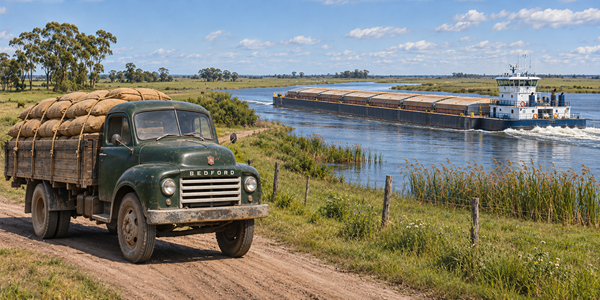
In 2024, at the Protagonistas del Agro event organized by the Dolores Agricultural Association, Carlos recalled his early days as a farmer, when he had to drive a Bedford truck carrying eight tonnes of flax in sacks to Montevideo.
Those of us who lived through that era know exactly what that meant.
Mechanization and the shift from handling grain in sacks to bulk storage and transport brought about a genuine agricultural revolution, in which Carlos played an active part.
In the late 1970s, a group of farmers led by his brother Jorge established OMUSA (Ombúes y Miguelete Unidos S.A.) to open new markets for Uruguayan barley.
Carlos took on an increasingly prominent commercial role, and the search for opportunities in Brazil would lead to the establishment of Maltería Uruguay in Nueva Palmira, later incorporated into the Ambev group.
As Carlos recalls, during the 1990s barley cultivation reached thirty thousand hectares, involving 328 farmers.
In May 2024, Parliament declared Ombúes de Lavalle the National Capital of Barley.
The birth of Fadisol
Fadisol S.A. was founded in 1979, beginning modestly in a shed in Ombúes de Lavalle, selling seeds and exporting honey.
It subsequently introduced fertilizers, new wheat varieties, agricultural machinery and production technologies.
The construction of its grain storage and seed processing facility in 1998, agreements to market crop genetics developed by INIA, and ventures in Brazil and Paraguay established a company with regional reach that remained true to its roots in rural Uruguay.
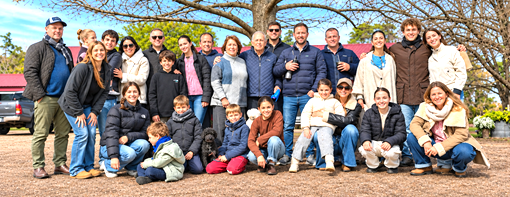
Foderé Borrás family with their seven children and nineteen grandchildren at La Concordia Ranch.
Business and family
In 2000, Carlos began studying family business management and sought specialist advice to prepare for generational succession.
But long before that, he had something essential: the presence of Inés, whose decisive importance in his career he has publicly acknowledged.
As Inés herself recognizes, one of the greatest challenges of their married life has been learning to complement each other through the varied circumstances they have faced.
Those of us fortunate enough to have known them since their youth can appreciate how much merit lies in that family achievement.
When life imposes its terms
In April 2014, three generations of the Foderé family celebrated the opening of Fadisol’s new logistics facility near Nueva Palmira.
On February 6, 2015, the collapse of one of its silos claimed the lives of two young workers, aged eighteen and twenty.
Two families suffered an irreparable loss, and an entire community was shaken.
The accident led to technical investigations and legal proceedings, and it is not for me to pass judgment on who was responsible.
Nine years later, Carlos publicly acknowledged that what had happened had changed his entire family.
Some events cannot be measured in balance sheets, and no subsequent success can erase a tragedy of that kind.
A new gateway to the world
Long before that episode, Carlos had begun promoting a project that went beyond his company’s interests: making use of the navigable connection between Laguna Merín and Lagoa dos Patos through the São Gonçalo Canal.
In 2008, he acquired land to develop a port terminal on the Tacuarí River, and the following year Hidrovía del Este S.A. was established.
The initiative seeks to connect agricultural and forestry production in northeastern Uruguay with the Brazilian port of Rio Grande.
For years, Carlos has promoted the project with successive governments in both countries.
In September 2026, it emerged that Brazil had contracted the dredging works needed to improve navigability, with work expected to begin in the first months of 2027.
Permits, investments and other arrangements are still outstanding, but that dream now seems closer.
The ability to look to the horizon
Between those eight tonnes of flax in sacks that Carlos carried in his Bedford and the barges that might one day navigate from the Tacuarí River to Rio Grande lies much of the history of Uruguay’s agricultural modernization.
And there, too, lies the life of my friend.
A life of achievements, affection, responsibilities, joys and sorrows that I am honored to have shared as a friend since our youth.
Reflecting on his achievements, Carlos acknowledges that his greatest asset is the family he has built with Inés: their seven children and nineteen grandchildren.
Because building a country is not simply about creating businesses, generating employment or opening markets.
It is also about thinking of those who will carry on our work when we are no longer here.
Carlos Foderé continues to look toward that horizon.
Uruguayan agricultural modernization
Family business succession
Regional logistics integration
Continue reading in From Lafone to Jodal
