
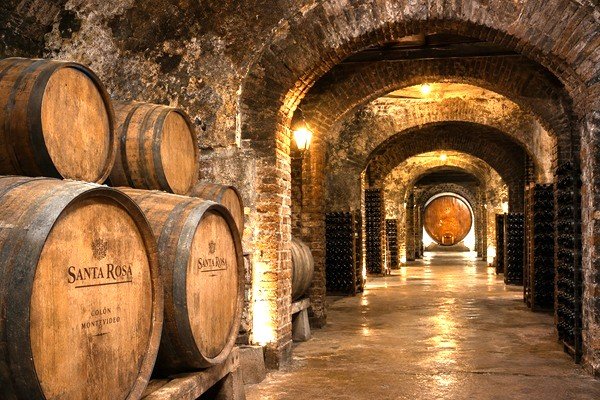
From the vineyards of Colón to international racetracks: the story of a century-old winery and Juan José Passadore’s return.
In March 1982, I traveled from Tacuarembó with my Formula Renault car to compete in the season’s opening race in Punta del Este.
The series was organized by Pedro Passadore, and the race had an exceptional starter: none other than Niki Lauda, who had just returned to Formula One.
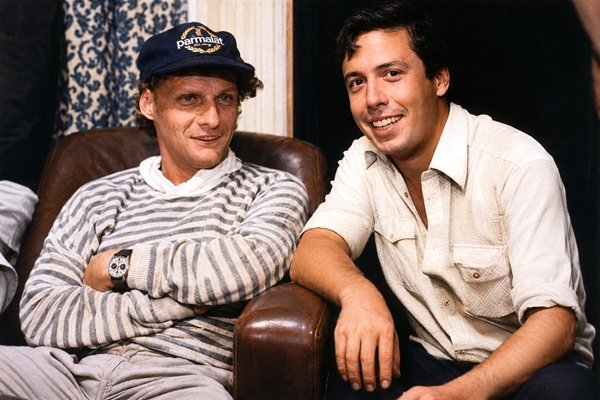
Punta del Este, 1982. The author with Niki Lauda, following the Formula Renault race organized by Pedro Passadore.
I also remember racing against Daniel “Peti” Mutio at El Pinar.
Back then, I associated those surnames much more with racing cars than with wine.
I had no idea that they were connected to a business story that had begun more than a century earlier, among the small farms and vineyards of Colón.
Behind one of Uruguay’s most traditional wineries stood a succession of immigrants, industrialists, athletes, racing drivers, and entrepreneurs who seemed to have initiative in their blood.
When Colón Smelled of the Grape Harvest
The story began in 1871, when Marco Passadore and Filomena Brasesco arrived from Genoa and settled on the outskirts of Montevideo.
They purchased land that had belonged to the Musto family, in the area of what is now César Mayo Gutiérrez Avenue, and put down roots there.
They had ten children, and over time the properties were divided among their descendants.
In 1898, Juan Bautista Passadore received the plot of land on which Bodega Santa Rosa would begin to take shape.
That same year, he made his first wines from a harvest of just 4,300 kilograms of Nebbiolo grapes.
In 1900, he married Rosa Saettone, beginning a new chapter for the family business that would eventually become a benchmark in Uruguay’s wine industry.
Colón was very different then from the neighborhood we know today.
Small farms, vineyards, and immigrant families’ homes existed alongside an emerging industrial sector.
Harvest festivals were major community events.
An account from 1917 describes a theatrical performance in which Bacchus sat atop an enormous illuminated barrel, with a cascade of red fireworks pouring from it to imitate wine.
The people of Colón knew how to enjoy themselves.
And they knew how to work.
By 1924, Santa Rosa was already producing 120,000 liters a year.
That year, Ángel Mutio, a young man of Basque descent, joined the winery and took on administrative responsibilities. In 1925, he married Yolanda Passadore, Juan Bautista’s daughter.
Thus began a union between two surnames that would accompany the winery’s history for generations.
A Small City Underground
Santa Rosa was not content merely to make wine.
To compete on quality,
it needed knowledge, techniques, and equipment that were extraordinary for Uruguay’s industry at the time.
Excavation of the underground cellars began in 1928.
Enormous oak vats arrived from France, and by about 1938 the subterranean facilities covered roughly 4,000 square meters.
The Colón establishment had effectively built another winery beneath the surface, where wines could age protected from light and temperature fluctuations.
One of the driving forces behind this transformation was Albérico Passadore, Juan Bautista’s son.
A figure worth pausing over.
He had been a South American pole-vault champion, and perhaps he brought to winemaking some of the competitive determination that marks a fine athlete.
After learning about French techniques, he set out to produce sparkling wines by the traditional method of fermentation in the bottle.
That initiative led to the development of Fond de Cave, a brand that would accompany family celebrations for generations.
The winery grew, hired specialists, experimented with grape varieties, and expanded its activities.
It was no longer simply one family’s venture, but an industry that accumulated knowledge, trained workers, and helped shape the identity of an entire area of Montevideo.
From Oak Barrels to Lotus Cars
But the Passadores and Mutios had other interests.
One of the most surprising was motor racing, a passion that took them well beyond El Pinar.
In 1969, Jorge Mutio joined Richard Vignoles and Edgardo Boschi in founding Lotus Argentina, a company that would manufacture the celebrated Lotus Seven under license.
The venture was based in Martínez, in Buenos Aires Province, and maintained direct ties with Lotus Components in England.
In January 1971, Colin Chapman, the legendary founder of Lotus, visited the facilities accompanied by Mike Warner, one of the leading figures in the British organization.
That a member of a family associated with a winery in Colón should take part in such an industrial adventure says much about the breadth of their entrepreneurial interests.
Pedro Passadore also had a distinguished motor-racing career, including Formula Three competitions in England in 1973.
Years later, he would organize the Uruguayan Formula Renault series in which I had the opportunity to racei, thanks to AUVO and its then-president, José Botta..
Motor racing, then, was no isolated eccentricity.
It was part of a family tradition of athletes, technicians, and entrepreneurs willing to explore pursuits far removed from winemaking.
When the Past Is No Longer Enough
Family businesses can pass down knowledge, reputations, and personal ties for generations.
But no history, however distinguished, can guarantee continuity.
Markets change.
And Santa Rosa endured crises, changes in ownership structure, and financial difficulties that gradually weakened its position.
Tradition was no longer enough.
More than a century after that first Nebbiolo harvest, the winery faced an uncertain future.
It seemed to be approaching an ending that no one in the days of Juan Bautista, Albérico, or Ángel Mutio could have imagined.
And then another Passadore appeared.
Juan José Returns
The curious thing is that Juan José Passadore had never been a winemaker.
He was a descendant of Marco and Filomena, but belonged to a branch of the family whose business activities had developed outside Santa Rosa.
His grandfather, also named Juan José, had inherited land from the old family property near what we now know as Route 102.
The present-day Juan José began working at a very young age, tried his hand at various trades, and developed businesses in transportation, trucks, spare parts, and machinery.
He had learned to build businesses without relying on the family’s winemaking tradition.
Yet he held on to something that appeared on no balance sheet: his childhood memories of Santa Rosa.
He remembered visiting the winery, its facilities, the industrial activity, and the plantations stretching out around it.
In November 2021, when the winery’s financial situation led those in charge to ask him for assistance, he faced a decision that went beyond strictly commercial calculations.
This was not a matter of investing in a business he knew particularly well, or continuing to run one he had previously managed. It meant accepting the risks of recovering a family heritage that had been part of life in Colón for more than a century.
In an interview published in 2022, he summed up how he felt in a simple phrase: “I can’t let it go under.”
And he got involved.
Outstanding obligations had to be addressed, facilities restored, equipment acquired, processes reorganized, and commercial operations renewed.
Equally important was preserving something as valuable as the buildings and brands: the knowledge of workers who, in some cases, represented successive generations connected to the winery.
The recovery effort included new products, the modernization of sparkling wines, and the opening of the historic premises to the public through wine-tourism experiences.
The cellars, for decades associated almost exclusively with the work of winemakers, began welcoming visitors interested in discovering a piece of Uruguay’s industrial history.
Juan José did not come to Santa Rosa to manage an inheritance in comfort.
He came to build a business, having already shown in entirely different fields that he understood the challenges of creating and sustaining an enterprise.
A Story Still Being Written
There is an image I find particularly evocative: that of a boy walking through Santa Rosa, unaware that many years later he would take on the task of restoring it.
While other family members had taken the Passadore name into athletics, onto international racetracks, and even into the manufacture of Lotus cars,
Juan José had followed his own path through trucks and commercial ventures.
And in the end, he returned to the place where that family story had begun.
We do not know what new challenges Santa Rosa will face or what the ultimate results of its recovery will be.
Businesses depend on daily work, their products, their customers, and their ability to compete—not on memories alone.
But some decisions deserve recognition for what they represent.
In 1871, Marco Passadore and Filomena Brasesco purchased land in Colón with their family’s future in mind.
In 1898, Juan Bautista turned part of that land into a winery.
More than 120 years later, when that legacy was at risk of disappearing, another descendant decided to invest in its future.
And as I think back to those distant days in 1982, the Formula Renault cars, Pedro Passadore, Peti Mutio, and that photograph with Niki Lauda,
I realize that perhaps this family’s most interesting story does not lie in its sporting victories.
It lies in that old winery in Colón, which has survived so many changes.
Because championships end, cars grow old, and businesses, too, can reach their final turn.
But Juan José Passadore decided that Santa Rosa still had more laps to run.
Colón’s industrial heritage
Motor racing and family entrepreneurship
Business revival and continuity
Continue reading in From Lafone to Jodal