
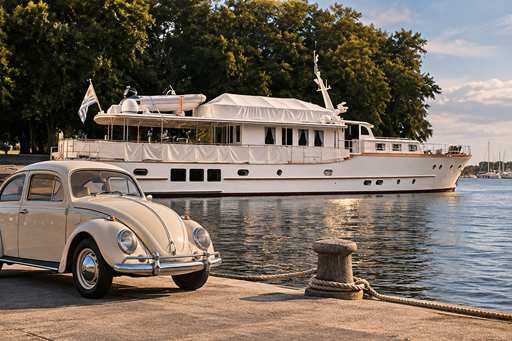
The Metejón, Volkswagen’s industrial venture in Nueva Palmira, and the continuity of a Uruguayan business family.
From the Punta del Este of my teenage years, I remember certain houses, a few people and, above all, a boat: the Metejón, the Lestido family’s magnificent motor yacht, which seemed to dominate the bay each summer.
My parents owned a house opposite the old OSE water-tank square, now Plaza de los Artesanos.
It was called Albina, a solid three-story chalet with a stone-clad ground floor, in the Cattaneo style.
I spent unforgettable summers there.
Next door lived Susana Nunes, whom I knew personally.
She was a niece of Fernando García Casalia, the tobacco industrialist and art collector, and was connected by marriage first to the Manini Ríos family and later to the Lestidos.
Years later, she also took part in the institutional and cultural life of the Punta del Este Yacht Club.
I never dealt personally with the Lestido businessmen, but to me their surname was associated with that boat.
The impression was no exaggeration: an article in El País would later say that the Metejón “reigned” during the 1960s and 1970s.
It even had its own telephone at a time when such a service was far from commonplace aboard a yacht.
The story of that vessel offers an unexpected introduction to a family that has sustained four generations of business activity.
A surname that became a business
The first Julio César Lestido entered the automobile trade in partnership with Travieso in the late 1920s.
The company bearing his name was established in 1947 and, in April 1950, became Volkswagen’s representative in Uruguay.
The first Beetles were offered at a showroom on the corner of 18 de Julio and Acevedo Díaz.
With its unmistakable shape and rear-mounted engine, the car earned a place on Uruguay’s streets and made Lestido a central figure in a commercial relationship now more than seventy-five years old.
After the founder died in 1957, his son Julio Manuel succeeded him, taking an import business into an ambitious industrial venture.
Nueva Palmira and the industrial adventure
In 1962, Julio Manuel set up a Volkswagen assembly plant in a former oil mill in Nueva Palmira.
Assembly, painting, upholstery and metalworking were all carried out there; at its peak, the operation employed some four hundred people.
For that city, it was more than just a factory.
It meant jobs, training and an important part of its identity.
Successive economic upheavals brought production to a halt and then back again, until the plant finally closed in 1992.
The company managed to reinvent itself, but Nueva Palmira lost an industry that had shaped several generations of workers.
A Volkswagen for one dollar
I remember a delightful anecdote from that period, although oral tradition has probably shifted its setting.
Eduardo Víctor Haedo is said to have expressed a wish to have a Volkswagen for his daughter Beatriz.
Julio Manuel Lestido wanted to give him one, but Haedo insisted on paying for it.
The solution was to issue an invoice for one dollar.
“If it’s that cheap, I’ll take two!” he is said to have replied.
Julio César Lestido himself recounted the episode in a 2021 interview, without linking it to the inauguration of the Nueva Palmira plant, as I had remembered it.
He also explained that Haedo never actually took both cars.
An anecdote need not be accurate in every detail for us to recognize the humor of an era and the personal closeness that characterized certain business relationships.
The challenge of enduring
Julio Manuel died in 1988 and management passed to his five children, on the eve of a profound transformation of the automobile market.
The family moved away from assembly, strengthened distribution and expanded its activities to brands such as Audi and MAN, as well as Volkswagen trucks.
Continuity, however, depended on more than making the right commercial decisions.
The Lestidos established rules for family governance, brought in independent directors and professionalized management.
Members of the fourth generation are not guaranteed a position simply because they bear the family name: they must demonstrate that they are qualified.
It is a lesson that extends well beyond this company.
Inheriting shares is not the same as inheriting the ability to lead.
A Chamber that learned to change, too
I know another side of Julio César Lestido through my own experience at Uruguay’s National Chamber of Commerce and Services.
I joined its board in 1993 as a representative of the interior, when I chaired the Tacuarembó Commercial Center and served as vice-president of CEDU.
I remained a board member for nearly fourteen years, initially drawn by the warmth of that group of leaders.
I promoted the creation of an environmental committee and conceived the Profitable Associative Environmental Management project, GAAR, which secured funding from the IDB/MIF in 2005.
To work on implementing it, I had to resign from the board in 2006, and I never rejoined it.
That Chamber had a distinguished tradition, but it also retained some of the characteristics of a closed club.
It was a not-for-profit corporation whose effective governance was tied to a historic core of shareholders.
As a business leader from outside Montevideo, I found that lack of representation obvious, although I never made it a point of confrontation.
I remember Julio Lacarte Muró’s presidency with admiration.
Above all, I remember the work of two women who were part of the institution’s very soul: the economist María Dolores Benavente, intelligent and rigorous, with whom I worked on GAAR, and Mabel Calvo, whom I first knew as a telephone operator and who, some four decades later, is still there, close to everyone and attentive to everything.
All too often, we tell the history of institutions solely through the people who preside over them.
María Dolores and Mabel each represent, in their own roles, a continuity that rarely receives the recognition it deserves.
Lestido became president of the Chamber in 2017 and faced a difficult restructuring.
The effort to reform its legal status gathered momentum later, during Daniel Sapelli’s presidency, and was completed under Lestido in December 2024, when the former corporation became a not-for-profit civil association, broadening participation by its members and business associations from the interior.
Having known the earlier structure from within, I can particularly appreciate the significance of that change.
What endures
In 2025, Volkswagen marked seventy-five years of its commercial relationship with Lestido, its longest-standing representative in the Americas.
But the family’s history cannot be contained in that anniversary alone.
There is the industrial commitment to Nueva Palmira, the adaptation to changing times, the organization of succession and the contribution to a business institution that finally dared to reform itself.
And there are Susana, María Dolores and Mabel, women who appear in this story from different places and deserve to be remembered.
When I recall the Metejón in the bay and that one-dollar Volkswagen, I think enduring is not about keeping everything intact, but about knowing what to pass on and what to change.
Key themes: Family business history; Industrialization in Nueva Palmira; Governance and institutional continuity
Family business history
Industrialization in Nueva Palmira
Governance and institutional continuity
Continue reading in From Lafone to Jodal
