
From TCS to Xeniors, a career defined by the ability to connect Uruguay with global companies, capital and talent.
In 2002, one of the largest technology operations Uruguay would eventually host consisted of just fifteen people.
Gabriel Rozman had personally selected them, and those hires marked the beginning of Tata Consultancy Services’ presence in Montevideo.
Two decades later, TCS had become one of the country’s major technology employers, and that decision had helped prove something that seems obvious today but was not at the time: Uruguay could sell knowledge to the world.
Rozman did not found Tata or Uruguay’s software industry.
His importance is harder to describe: for much of his life, he made separate worlds begin to meet.
His parents arrived in Uruguay from a Europe sliding towards war and persecution.
The country that welcomed them eventually became, for their son, a debt he would never forget.
Rozman has explained that bringing Tata to Uruguay also had this personal dimension: giving something back to the country that had welcomed his family and given him a public education.
He began working at a very young age, spent time at Sudamtex and, in the early 1960s, left for the United States with little money and limited English.
His first experience was in Mississippi, where racial segregation was still in force.
He has described the bewilderment he felt when a bus driver forced him to leave a seat reserved for Black passengers.
For a young Uruguayan, the son of European Jewish immigrants, that division was difficult to understand.
He moved to California, studied Economics and Business, completed an MBA at UCLA and began an international career.
For thirty years, Ernst & Young was his great business school.
There, a trait emerged that would recur throughout his career: Rozman seemed drawn to what did not yet exist.
When he saw the opportunities in Eastern Europe, he promoted new operations and took part in opening offices in Budapest, Prague and Warsaw.
He had learned how to be an entrepreneur inside a corporation.
At sixty, he did exactly the opposite of what might have been expected.
He left a position at Ernst & Young to join Tata Consultancy Services for compensation that, as he later recalled, was equivalent to a quarter of what he had been earning.
He did not need to start again.
He wanted to.
The challenge was to develop Latin America for a major Indian company. Mexico was the first option, then Argentina, but the crisis and the corralito closed that route.
Uruguay ultimately became the point of entry.
TCS began here in 2002 with those fifteen employees.
The Latin American operation grew to several thousand people.
But for Uruguay, the important fact is not only the number of jobs.
Tata helped demonstrate that a small, peripheral country without a large domestic market could become a platform for global technology services.
For generations, Uruguay had exported beef, wool, leather and rice.
Now it could export intelligence.
Nor did retirement follow Tata.
Rozman continued investing, advising companies, serving on boards and supporting entrepreneurs.
He chaired Endeavor Uruguay and, through Tokai Ventures, once again acted as an intermediary between Uruguayan talent and international capital.
He also took part in transactions such as the one that led to the creation of Qubika, where the same pattern reappeared: identifying parties capable of building something together and getting them to trust one another.
That is why describing him simply as a bridge-builder may be insufficient.
Rozman seems to have specialised in something more difficult: building trust among people from different companies, cultures and countries.
He did the same across generations.
I came to know Gabriel Rozman not only through his business career.
I shared with him initiatives related to senior entrepreneurship and was invited by Rozman himself to join the founding group of Xeniors, where I served as alternate statutory auditor.
Xeniors was built around a pioneering idea: that after the age of fifty or sixty, accumulated experience did not necessarily have to lead to retirement, but could instead be transformed into new ventures and new life projects.
Rozman did not preach reinvention as a theory.
He practised it.
His career is not merely the story of a Uruguayan executive who built an outstanding international career.
It is the story of someone who learned to think beyond the natural dimensions of his country and then spent decades trying to broaden them.
Eastern Europe, India, China, the United States, international capital, technology, young entrepreneurs and older entrepreneurs all appear as chapters in the same conviction: Uruguay could be small without thinking small.
In that respect, Gabriel Rozman holds a distinctive place in the journey from Lafone to Jodal.
He represents the moment when an economy historically tied to its natural resources began to understand that it could also integrate globally through knowledge, technology and talent.
Another generation would follow, one that would no longer need to bring the world to Uruguay because it would begin creating, from Uruguay, companies capable of going out into the world.
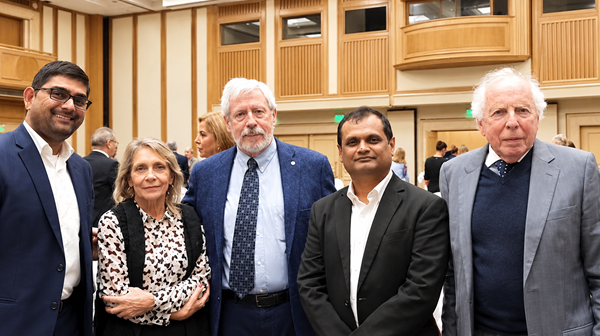
Archive photograph. Gabriel Rozman with TCS executives Rahul Jain and Srinivasa Kumar, the author of this article, Santiago Pereira Testa, and his wife, Tere Camejo.
Uruguay’s ability to create international opportunities also requires preserving the security and trust that make entrepreneurship and investment possible.
Uruguay’s technology transition
Global business bridges
Reinvention across generations
Continue reading in From Lafone to Jodal
